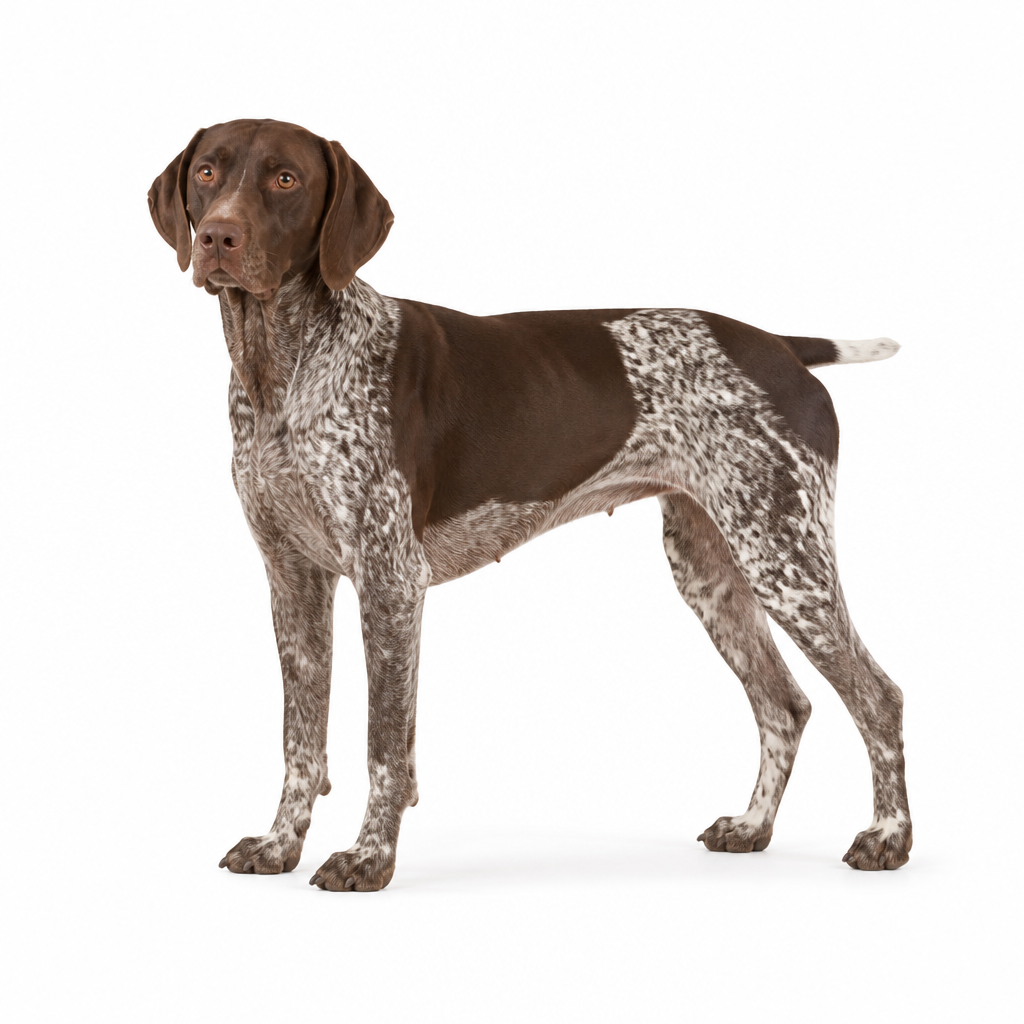
German Shorthaired Pointer full body portrait
Breed Profile

German Shorthaired Pointer

Sporting Group · Germany · Lives 12-14 yrs

If you're a runner, hiker, or hunter looking for a four-legged partner who can keep up with anything you throw at them, the GSP might be your perfect match. Just know that 'a walk around the block' won't cut it — these dogs need real athletic output every single day.

High EnergyGreat Hiking PartnerWorking Dog HeritageDaily Exercise Required
Family
Trainability
Affection
Energy
Apartment
Beginner
SizeMedium-Large
Height1 ft 10 in – 2 ft 0 in
Weight51–60 lbs
Lifespan12-14 yrs
Exercise120 min/day
OriginGermany
Evidence-based · AKC · FCI · Merck Vet Manual Research confidence 9/10
The Bottom Line

If you're a runner, hiker, or hunter looking for a four-legged partner who can keep up with anything you throw at them, the GSP might be your perfect match. Just know that 'a walk around the block' won't cut it — these dogs need real athletic output every single day.

6.2/ 10
Highly trainableDeeply affectionateProne to health issues
At a Glance

Breed Snapshot

Twelve core traits scored 1–10 from veterinary and kennel-club consensus.

Strengths
Energy10/10
Trainability8/10
Affection8/10
Exercise Need10/10
Kid-Friendly7/10
Beginner-Friendly3/10
Things to Know
Apartment Living1/10
Stranger-Friendly6/10
Shedding4/10
Drooling1/10
Grooming Effort2/10
Health Risk8/10
Compatibility

Is This the Right Dog for You?

A five-second gut check before you read the details.

Excellent Match If You…

  • You are a runner, hiker, hunter, or dedicated outdoor athlete
  • You can provide a minimum of 2 hours of vigorous daily exercise
  • You have a large, securely fenced yard or access to open running space
  • You want a versatile sporting companion for hunting, field trials, or dog sports

Probably Not Ideal If You…

  • You live in an apartment, condo, or home without a yard
  • You have a sedentary lifestyle or work long hours away from home
  • You have cats, rabbits, or other small animals in your home
  • You are a first-time dog owner without sporting-breed experience
Meet This Breed

Meet the German Shorthaired Pointer

“If German Shorthaired Pointer were a person…”

If the GSP were a person, they'd be the tireless endurance athlete who signs up for the ultramarathon and immediately asks what's next. Driven, affectionate, and perpetually in motion, they need a mission or they'll invent one. Brilliant and biddable once their body is tired, they're a whirlwind of frustration when it isn't. They bond hard and hate being left behind, physically or emotionally. All engine and open heart, they thrive with someone as active and ambitious as they are.

Exercise & Energy

Exercise & Energy

10/10
Energy
Daily exercise
120 min
Structured activity, most days
Energy level
10/10
Mental work
9/10
Needs a job to stay balanced
Endurance
10/10
Compared with the average dog
  • Requires 75% more exercise
  • Needs more mental stimulation
Reality Check

If your schedule cannot consistently support 120 minutes of daily activity, this breed is unlikely to thrive — pent-up energy becomes barking, chewing, and anxiety.

Trainability

Trainability & Behaviour

8/10
Trainable
Trainability
8/10
Learning speed
9/10
Housebreaking
3/10
Higher = harder

Works best with

  • Positive reinforcement with play and toy rewards
  • Field training for natural pointing and retrieving instincts
  • High-energy, varied training sessions
  • Early socialization and impulse control exercises

Common challenges

  • Hyperactivity and restlessness if under-exercised
  • Destructive behavior from boredom (chewing, digging)
  • High prey drive — chasing small animals, birds, cats
  • Jumping on people
Compared with the average dog
  • About average trainability
Reality Check

Intelligence is not obedience. Without early, consistent training this breed's default setting is hyperactivity and restlessness if under-exercised — plan for real time in the first year.

Grooming

Grooming & Shedding

1/10
Coat effort
Shedding
4/10
Drooling
1/10
Coat effort
1/10
Brushing
Weekly
Professional grooming
Rarely needed; every 8-12 weeks optional
Bathing
Every 6-8 weeks or as needed
Compared with the average dog
  • Sheds a little less than average
  • Less grooming than average
Reality Check

Low-maintenance still means maintenance — nails, ears, and teeth need routine care even when the coat is easy.

Health

Health & Longevity

8/10
Health
Health rating
8/10
Life expectancy
12-14 years
Routine vet / yr
$450

Screen breeders for

  • Hip evaluation (OFA)
  • Elbow evaluation (OFA)
  • Ophthalmologist evaluation
  • Cardiac evaluation

Watch for

  • Hip dysplasia
  • Bloat (gastric dilatation-volvulus)
  • Von Willebrand's disease
  • Cone degeneration (day blindness)
  • Entropion
Compared with the average dog
  • Lives ~1 yr longer than average
  • Costs less per year than average
Reality Check

Insist on health-tested parents and budget for the unexpected — hip dysplasia and similar issues can mean four-figure vet bills. Pet insurance is worth pricing before you commit.

Compatibility

Household Compatibility

How well the German Shorthaired Pointer fits different households and living situations, scored 0–100.

Young children
60/100
Teenagers
80/100
Singles
65/100
Seniors
20/100
Apartment living
10/100
Other dogs
70/100
Cats
25/100
Active owners
95/100
Lifestyle Match

Lifestyle Match

A quick three-way read on fit — where this breed shines, where it can work, and where it usually struggles.

Perfect for

An ideal match

  • Very active, experienced outdoor enthusiast
  • Active household with large fenced property
  • Very High-energy household ready for daily exercise
Good fit

Workable with effort

  • Committed singles
  • Active couples
  • Suburban homes with a yard
Poor fit

Think twice

  • You live in an apartment, condo, or home without a yard
  • You have a sedentary lifestyle or work long hours away from home
  • You have cats, rabbits, or other small animals in your home
Cost of Ownership

Monthly Ownership Dashboard

What owning a German Shorthaired Pointer really costs each month. Recurring essentials plus a recommended set-aside toward the big, unexpected vet bill — estimates in USD.

Food
$50/mo
Insurance
$38/mo
Routine vet
$33/mo
Grooming
$8/mo
Training
$50/mo
First-year, amortised
Emergency savings
$83/mo
Toward a $3,000 fund
Total monthly estimate
$262/mo
≈ $3,150 per year
Compared with the average dog
  • Costs less per year than average
Reality Check

Budget around $262 a month before you fall in love with a puppy. Underestimating ongoing cost — especially emergency vet care — is a leading reason dogs are surrendered.

Time Commitment

Weekly Time Commitment

Estimated hands-on hours per week — roughly 36.8 hours of active involvement, on top of simply living together.

Exercise14.0 h/wk
Training4.6 h/wk
Grooming0.7 h/wk
Social interaction12.0 h/wk
Mental stimulation5.5 h/wk
Reality Check

That is about 36.8 hours every week, week after week, for the dog's whole life. If your calendar can't find it now, it won't magically appear later.

Life Stages

Timeline: Puppy to Senior

What to expect as your German Shorthaired Pointer grows — and the behavioural shifts that catch new owners off guard.

1
Puppy0–6 months

High-drive and precocious — needs early outlets and socialisation. Bores fast, so channel that energy before it channels itself.

2
Adolescent6–24 months

Relentless energy and independence peak; without hard daily exercise and training, frustration turns destructive.

3
Adult2–7 years

Tireless, affectionate, and biddable once exercised — an athletic partner that hates being left behind.

4
Senior7+ years

Finally downshifts but stays keen; keep them moving gently and mentally engaged to stay content.

A Day in the Life

A Day with a German Shorthaired Pointer

Your alarm goes off at 6 AM and your German Shorthaired Pointer is already vibrating with anticipation. You lace up your running shoes and head out for a 5-mile run — your GSP trots beside you effortlessly, barely breathing hard. Back home, a quick breakfast for both of you, then 15 minutes of obedience practice in the yard. They nail every command. Mid-morning, your GSP stares at the door. You throw a ball in the yard for 20 minutes of intense fetch sprints. Early afternoon, a hike at a local trail — off-leash in a secure area, your dog ranges ahead, nose to the ground, freezing in a perfect point when a bird flushes. By 4 PM, you're home, and they finally settle on their bed for a nap. Evening brings another 30-minute walk and some puzzle-toy time. After dinner, your GSP curls up beside you on the couch — calm, content, and satisfied. Tomorrow, you'll do it all again. Every day. Without fail.

By evening, after roughly 120 minutes of real activity, the German Shorthaired Pointer finally downshifts — leaning into your side, content, and already dreaming about tomorrow.

Myth vs Reality

Common Misconceptions

The myths that lead to mismatched adoptions — and the reality behind each.

GSPs are good apartment dogs because they're 'medium-sized'
their energy level, not their size, makes them one of the worst apartment breeds
GSPs will calm down after puppyhood
they remain extremely high-energy throughout their life, often into their senior years
GSPs can live with cats if raised together
their prey drive is instinctive and many GSPs will chase cats regardless of socialization
A daily walk is enough exercise for a GSP
they need 2+ hours of vigorous activity, not leisurely walks
Readiness

Before You Commit: Checklist

Tick these off honestly before bringing a German Shorthaired Pointer home. Every unchecked box is a reason to wait.

  • Space for a medium-large dog with a fenced yard
  • ~120 minutes of daily exercise, rain or shine
  • A budget of roughly $262/month for its whole life
  • Time for weekly grooming
  • Commitment to early training and socialisation
  • A routine that avoids leaving it alone more than 4 hours
  • Readiness for a 12-14-year commitment
  • A relationship with a vet and a plan for emergencies
FAQ

Frequently Asked Questions

Is the German Shorthaired Pointer good with children?
With care — the German Shorthaired Pointer scores 7/10 for child-friendliness. Supervision and early socialisation are essential, especially with young children.
How much exercise does a German Shorthaired Pointer need?
Plan on about 120 minutes of purposeful activity every day — this is an athletic breed that needs a real outlet.
Does the German Shorthaired Pointer shed a lot?
Moderately — shedding rates 4/10, and it does best with weekly.
Is the German Shorthaired Pointer good for first-time owners?
Not usually the easiest first dog. First-time-owner suitability scores 3/10.
How long do German Shorthaired Pointers live, and what health issues are common?
Typically 12-14 years. Be aware of hip dysplasia and bloat (gastric dilatation-volvulus).
Can a German Shorthaired Pointer live in an apartment?
Generally not recommended — apartment suitability scores 10/100.